TrustCloud raises $15M, led by ServiceNow Ventures, with participation from Cisco Investments. Read more →

Why every organization needs an Acceptable Use Policy (AUP): Exploring legal and security implications

Estimated reading: 19 minutes 1361 views

Overview

This article highlights the critical importance of an Acceptable Use Policy (AUP) for organizations. It details how an AUP mitigates legal and security risks by setting clear guidelines for technology use, preventing issues like data breaches and non-compliance with regulations such as HIPAA and GDPR.

Overall, it collectively argue that a well-implemented AUP, supported by robust GRC practices and tools, is essential for an organization’s legal protection, cybersecurity, and overall operational integrity.

Every organization, regardless of size or industry, must navigate complex legal and security terrains to safeguard its integrity and operational efficiency. An AUP serves as a cornerstone, providing clear guidelines on acceptable usage while mitigating risks and ensuring compliance with regulatory standards. Pass security reviews faster, save time and money on compliance audits, and mitigate risks to reduce financial liability.

What is an Acceptable Use Policy (AUP)?

An Acceptable Use Policy (AUP) is a formal document that outlines how employees, contractors, and other users can appropriately use an organization’s technology resources. It defines permitted and prohibited behaviors when accessing company networks, devices, internet, applications, and data.

The primary goal of an AUP is to protect the organization from security risks, legal liabilities, and operational disruptions caused by misuse or negligence. It also helps enforce compliance with industry regulations. By setting clear expectations, an AUP fosters responsible behavior, improves cybersecurity, and supports a culture of accountability within the workplace. Regular training and updates keep it effective and relevant.

A robust AUP does more than just set rules—it builds a framework for trust and security, crucial for today’s business climate. By implementing a comprehensive Acceptable Use Policy, organizations not only protect their assets but also foster a culture of responsibility and accountability. As you delve into the nuances of why an AUP is essential, you’ll discover its multifaceted impact on maintaining legal compliance, enhancing cybersecurity, and ultimately, steering your organization towards long-term success.

An acceptable use policy is a vital tool that every organization should adopt. To mitigate these risks, an Acceptable Use Policy (AUP) is developed. This policy serves as a set of guidelines that dictate how employees and users can utilize company resources, such as computers, networks, and internet access.

Why does every organization need an Acceptable Use Policy (AUP)?

An Acceptable Use Policy (AUP) is essential for any organization to establish a clear and consistent framework governing how employees, contractors, and other stakeholders can use company-provided technology and resources. Without an AUP, an organization leaves itself vulnerable to a range of legal and security risks.

  1. An AUP sets clear expectations regarding permissible activities on the corporate network. Employees need to know what constitutes acceptable and unacceptable behaviour to prevent inadvertent misuse of resources, which could lead to data breaches or the loss of sensitive information.
    Explicit guidelines help safeguard the organization’s assets from internal threats by minimizing unauthorized access and use.
  2. Having a well-documented AUP can protect an organization from potential legal liabilities. In today’s regulatory environment, businesses must comply with various laws and industry standards regarding data protection and information security.
    A comprehensive AUP ensures that the organization meets these compliance requirements, thereby reducing the risk of legal consequences and financial penalties.
  3. An AUP fosters a culture of accountability within the organization. When everyone understands the rules and consequences of non-compliance, it encourages responsible behavior and enhances overall security practices.
    Clear policies also serve as a reference point during employee training and can be used to address any violations in a structured manner.

The need for an AUP in any organization is paramount for maintaining legal compliance, protecting data integrity, and promoting a secure working environment.

Have you checked out TrustTalks? Your go-to podcast series by TrustCloud exploring the evolving landscape of security and GRC.

TrustTalks

Legal implications of not having an acceptable use policy

Without an Acceptable Use Policy in place, organizations expose themselves to significant legal risks. Firstly, the absence of an AUP can make it difficult to hold employees accountable for their actions when using company resources. This lack of clarity can lead to misuse and even illegal activities, such as copyright infringement, harassment, or dissemination of confidential information.

In addition, without a clear AUP, employees may inadvertently engage in activities that violate laws or regulations. For instance, downloading copyrighted material without permission can result in legal consequences for both the individual and the organization. Without an AUP to outline these boundaries, employees may unknowingly engage in activities that expose the organization to potential lawsuits.

Furthermore, in the absence of an AUP, organizations may struggle to defend themselves against claims of negligence. If an employee’s misuse of company resources leads to harm or loss for another party, the organization can be held liable for failing to establish guidelines and enforce compliance.

To avoid these legal pitfalls, having a well-crafted AUP is essential. By clearly outlining acceptable behavior and the legal consequences of non-compliance, organizations can protect themselves from legal liabilities and ensure employees understand their responsibilities. 

Read the “Acceptable use policy guidelines: how to create and enforce one effectively” article to learn more!

Security implications of not having an acceptable use policy

An Acceptable Use Policy (AUP) is a key component of any organization’s cybersecurity framework. It sets clear guidelines on the appropriate use of an organization’s resources, including networks, computers, email, and other systems.
Without an AUP, several security implications can arise that may put the organization at risk. Below are the key security concerns associated with not having an acceptable use policy:

  1. Increased Risk of Insider Threats
    1. Potential Impact: Without clear usage guidelines, employees, contractors, or other insiders may inadvertently or maliciously misuse resources. Insider threats, whether intentional or accidental, can result in data breaches, unauthorized access to sensitive systems, and exposure to malware.
    2. Example: An employee might share sensitive information via personal email or cloud storage services, unaware of the security risks, leading to potential data leakage.
  2. Uncontrolled Access to Critical Systems
    1. Potential Impact: In the absence of an AUP, employees may misuse or abuse their access privileges to systems and data. This could result in unauthorized access to critical infrastructure, potentially leading to data theft, data alteration, or service disruption.
    2. Example: An employee might use company databases for personal projects or access restricted areas without proper justification, increasing the risk of exposure to vulnerabilities.
  3. Introduction of Malware and Ransomware
    1. Potential Impact: Without defined rules for safe internet usage and downloading practices, employees might visit unsafe websites, download unapproved software, or plug in unsecured external devices, thereby introducing malware, spyware, or ransomware into the network.
    2. Example: An employee downloads a free software tool from an untrusted website, inadvertently introducing malware into the company’s system, which could result in data loss or system downtime.
  4. Data Leakage and Loss of Confidential Information
    1. Potential Impact: Without an Acceptable Use Policy, employees may not be aware of how to handle sensitive data, leading to potential data leaks. This could include sending confidential information via insecure channels, storing sensitive data in unapproved cloud services, or mishandling personal data in violation of data privacy laws.
    2. Example: An employee may share sensitive customer information through unsecured means like personal email, exposing the company to data breaches and regulatory penalties.
  5. Non-Compliance with Regulatory Standards
    1. Potential Impact: Many data protection regulations, such as GDPR, HIPAA, or CCPA, require organizations to implement proper security measures to safeguard personal data. An AUP is often part of the compliance framework. Without it, the organization may face non-compliance issues, leading to fines and legal action.
    2. Example: A healthcare provider without an AUP may not properly secure patient data, potentially violating HIPAA regulations and incurring significant fines.
  6. Unauthorized Use of Corporate Resources
    1. Potential Impact: Employees or third parties may use company resources, such as bandwidth, storage, or computing power, for non-work-related activities (e.g., online gaming, personal streaming, or cryptocurrency mining). This can degrade system performance, increase costs, and expose the organization to new threats.
    2. Example: An employee might use company servers for personal cryptocurrency mining, which could not only slow down critical operations but also expose the system to security vulnerabilities inherent in such activities.
  7. Inconsistent Security Practices
    1. Potential Impact: Without an Acceptable Use Policy, security practices may vary across the organization. Employees may use different methods for handling passwords, sharing files, or accessing systems, which can create weak points in the security infrastructure.
    2. Example: Some employees might store passwords in insecure locations, such as text files on their desktops, while others may use strong password managers. This inconsistency weakens the overall security posture.
  8. Legal Liability
    1. Potential Impact: If an employee engages in illegal activity using company resources, such as downloading pirated content, the organization may be held legally responsible. This can result in lawsuits, reputational damage, and financial penalties.
    2. Example: An employee downloads copyrighted movies or software on a work device. The company could be liable for copyright infringement or face penalties under intellectual property laws.
  9. Unmonitored Use of External Services
    1. Potential Impact: Employees may start using external, unapproved services, such as cloud storage platforms, collaboration tools, or social media, for work purposes. These shadow IT activities can bypass the organization’s security controls, exposing sensitive data to third parties.
    2. Example: An employee stores company documents on a personal Dropbox account without the knowledge of IT, leading to potential data exposure if the account is compromised.
  10. Social Engineering Vulnerabilities
    1. Potential Impact: Employees who are not aware of phishing attacks, impersonation schemes, or other social engineering tactics may fall victim to them, compromising the organization’s security. An AUP typically includes training and guidelines to prevent such incidents.
    2. Example: An employee receives a phishing email disguised as a legitimate business request and unknowingly provides sensitive login credentials, allowing an attacker to gain access to the network.

Not having an Acceptable Use Policy leaves an organization vulnerable to a wide array of security risks, including data breaches, malware infections, insider threats, and legal liabilities. An AUP helps mitigate these risks by clearly defining acceptable behavior, ensuring consistent security practices, and protecting both the organization and its employees from potential threats. Establishing and enforcing an AUP is a critical step in maintaining a strong cybersecurity posture.

Read the “Crafting an effective acceptable use policy: Best practices for businesses” article to learn more!

Benefits

Having a well-crafted Acceptable Use Policy offers numerous benefits for organizations. Firstly, it establishes clear boundaries for acceptable behavior, promoting a productive and respectful work environment. By defining what constitutes acceptable use of company resources, an AUP helps prevent misuse or abuse, such as excessive personal use of the internet or social media during work hours.

  1. An AUP helps protect an organization’s reputation by preventing employees from engaging in activities that could damage the company’s image. By outlining guidelines for appropriate online behavior, organizations can ensure that employees are representing the company in a professional manner, both internally and externally.
  2. It plays a crucial role in protecting the organization’s sensitive data and intellectual property. By clearly stating the importance of data security and outlining procedures for handling confidential information, an AUP reduces the risk of data breaches and unauthorized access.
  3. It helps educate employees about the potential risks associated with using company resources and the internet. By raising awareness of cybersecurity threats, employees become more vigilant and are less likely to fall victim to phishing attempts, malware, or other cyber-attacks.

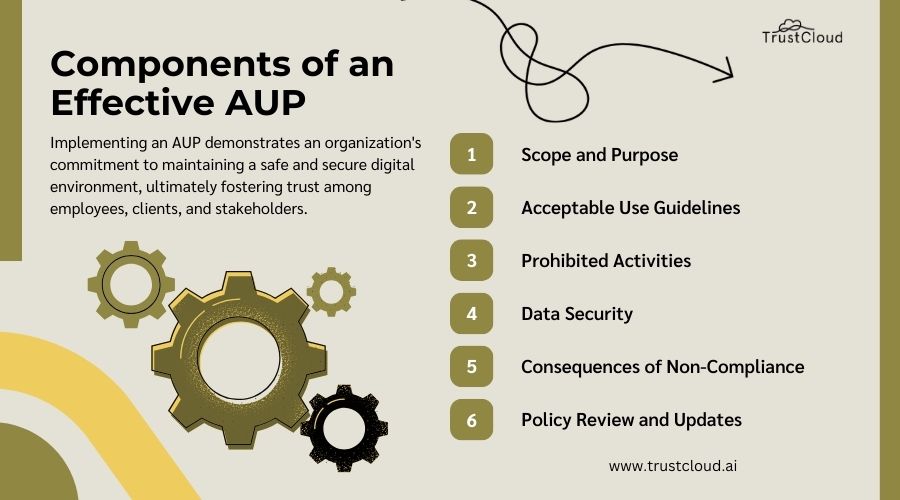
Overall, implementing an AUP demonstrates an organization’s commitment to maintaining a safe and secure digital environment, ultimately fostering trust among employees, clients, and stakeholders.
Acceptable Use policy
Components of an effective acceptable use policy

Components of an effective, acceptable use policy

To ensure the effectiveness of an Acceptable Use Policy, several key components should be included.

These components are:

  1. Scope and Purpose: Clearly define the purpose of the AUP and specify the resources and activities it covers. This section should also outline who the policy applies to, such as employees, contractors, and visitors.
  2. Acceptable Use Guidelines: Provide detailed guidelines on what constitutes acceptable use of company resources, including computers, networks, internet access, and email. This section should cover topics such as appropriate online behavior, personal use of company resources, and the use of social media.
  3. Prohibited Activities: Clearly state activities that are strictly prohibited, such as accessing or distributing illegal content, engaging in cyberbullying or harassment, or attempting unauthorized access to systems or data.
  4. Data Security: Outline the importance of data security and specify procedures for handling sensitive information. This should include guidelines for password management, data backup practices, and reporting security incidents.
  5. Consequences of Non-Compliance: Clearly communicate the consequences of violating the AUP, including disciplinary actions that may be taken. This section should also detail the process for reporting violations and the steps involved in investigating and resolving incidents.
  6. Policy Review and Updates: Specify how often the AUP will be reviewed and updated, ensuring that it remains relevant and effective in addressing emerging security threats and legal requirements.

By including these components in an AUP, organizations can create a comprehensive policy that addresses both legal and security considerations. 

Read the “Risk management policy: mastering power of risk in continuous improvement” article to learn more!

Tips for creating an acceptable use policy

Creating an acceptable use policy (AUP) is crucial for setting clear guidelines on the proper use of an organization’s resources. Start by defining the scope and objectives of the policy, ensuring it aligns with your organization’s mission and legal requirements. Clearly outline what constitutes acceptable and unacceptable behavior, providing specific examples to eliminate ambiguity.

It is essential to include provisions for data protection, cybersecurity measures, and the use of company devices and networks. Ensure that the policy is written in clear, concise language, avoiding technical jargon that might confuse users. Additionally, involve key stakeholders in the development process to gain diverse perspectives and foster a sense of ownership among employees. Regularly review and update the AUP to reflect emerging threats and technological advancements, ensuring its relevance over time. Communicate the policy effectively through training sessions and accessible documentation, emphasizing its importance and the consequences of non-compliance.

Finally, enforce the policy consistently, applying disciplinary actions fairly to maintain credibility and encourage adherence. By following these tips, organizations can create a robust acceptable use policy that protects their assets while promoting responsible usage among employees.

When creating an Acceptable Use Policy, organizations should keep the following tips in mind:

  1. Involve Relevant Stakeholders: Consult with legal, HR, IT, and other departments to ensure that the AUP addresses all necessary legal and security requirements.
  2. Use Clear and Concise Language: Make sure the AUP is written in plain language that is easily understandable by all employees. Avoid technical jargon or complex legal terms.
  3. Educate Employees: Provide training and awareness programs to ensure that all employees understand the AUP and their responsibilities. Regularly communicate updates and reminders to reinforce compliance.
  4. Tailor the AUP to the Organization: Customize the AUP to reflect the unique needs and culture of the organization. Consider industry-specific regulations, the organization’s risk appetite, and the specific digital resources being used.
  5. Seek Legal Review: Have the AUP reviewed by legal counsel to ensure it complies with relevant laws and regulations. This step is particularly important when dealing with international or industry-specific compliance requirements.

By following these tips, organizations can create an acceptable use policy that is tailored to their specific needs and effectively addresses legal and security considerations.

How to enforce an acceptable use policy

Enforcing an Acceptable Use Policy requires a proactive and consistent approach. Here are some steps organizations can take to ensure compliance:

  1. Communicate the AUP: Clearly communicate the AUP to all employees and require them to acknowledge their understanding and agreement. This can be done through training sessions, email notifications, or electronic signatures.
  2. Monitor and Audit: Regularly monitor and audit network traffic, system logs, and user activities to identify any potential violations. This can be done using security tools, employee monitoring software, or manual checks.
  3. Report and Investigate: Establish a process for employees to report suspected violations and ensure that all reports are promptly investigated. This encourages a culture of accountability and helps identify potential security incidents early.
  4. Enforce Consequences: Consistently apply the consequences outlined in the acceptable use policy for violations. This may include verbal warnings, written reprimands, suspension, or termination, depending on the severity of the offense.
  5. Update and Educate: Continuously update the AUP to address emerging security threats and legal requirements. Regularly educate employees on the importance of compliance and provide training on new policies or updates.

By enforcing the AUP in a fair and consistent manner, organizations can demonstrate their commitment to maintaining a secure digital environment and encourage employees to adhere to the policy.

Case Studies: organizations that suffered due to lack of an AUP

Several high-profile cases demonstrate the consequences of not having an Acceptable Use Policy in place. One such example is a multinational company that faced a significant data breach due to an employee unknowingly clicking on a malicious link. The absence of an AUP meant that the employee was not adequately trained to recognize phishing attempts, leading to the compromise of sensitive customer data.

In another case, a small business faced legal consequences when an employee engaged in cyberbullying through company email accounts. The lack of an AUP made it difficult for the organization to hold the employee accountable or defend against claims of negligence, resulting in reputational damage and legal expenses.

These case studies highlight the potential risks and negative consequences organizations face when they neglect to implement an AUP. The impact can range from financial losses and legal liabilities to reputational damage and loss of customer trust.

Resources for creating an acceptable use policy

Creating an effective Acceptable Use Policy may seem daunting, but there are resources available to help organizations develop a comprehensive and tailored AUP. Here are some recommended resources:

  1. Industry Associations: Many industry associations provide guidelines and templates for creating AUPs specific to their sector. These resources often incorporate industry-specific compliance requirements and best practices.
  2. Legal Counsel: Engage legal counsel with expertise in technology and employment law to ensure the AUP complies with relevant regulations and addresses legal considerations.
  3. Cybersecurity Organizations: Organizations specializing in cybersecurity often provide resources and best practices for creating AUPs that address the latest security threats and vulnerabilities.
  4. Government Agencies: Government agencies, such as the Federal Trade Commission (FTC) or the National Institute of Standards and Technology (NIST), offer guidelines and resources for creating AUPs that comply with legal and security standards.

Utilizing these resources can help organizations develop an Acceptable Use Policy that is robust, effective, and aligned with industry best practices.

Final thoughts

By establishing boundaries for acceptable behavior and clearly defining the consequences of non-compliance, an AUP protects organizations from legal liabilities and helps safeguard sensitive data. Additionally, an AUP promotes a security-conscious culture, reducing the risk of security incidents and ensuring employees are aware of their responsibilities.

By following best practices, involving relevant stakeholders, and consistently enforcing the AUP, organizations can create a safe and secure digital environment that fosters productivity and trust assurance. Implementing an AUP should be a priority for every organization, regardless of size or industry, to navigate the complex digital landscape and protect their interests.

Sign up with TrustCloud to learn more about how you can upgrade GRC into a profit center by automating your organization’s governance, risk management, and compliance processes.

FAQs

What is an Acceptable Use Policy (AUP)?

An Acceptable Use Policy (AUP) is a formal document that defines how employees, contractors, vendors, or anyone using an organization’s technology systems should behave. It outlines what is considered acceptable and unacceptable use of resources such as computers, mobile devices, email, internet access, and software applications.

The goal of an AUP is to minimize security risks, protect sensitive data, and ensure that employees understand their responsibilities when using company resources. It also serves as a reference point in case of misuse or policy violations and supports a safer, more productive digital work environment.

Every organization—regardless of size or industry—faces risks related to improper use of technology. From accidental data leaks to intentional misuse of systems, these threats can lead to serious consequences like data breaches, legal penalties, reputational damage, and financial loss.

An AUP helps prevent these issues by clearly communicating rules and expectations. It ensures that employees know how to handle company assets responsibly. Additionally, it shows stakeholders, regulators, and customers that the organization takes security and compliance seriously. In short, an AUP is a foundational element in managing digital risk and building a culture of accountability.

Many industries must follow strict data protection laws and security standards—such as GDPR, HIPAA, CCPA, and SOC 2. An AUP demonstrates that an organization has taken steps to inform users about proper data handling and acceptable system usage.

If an incident occurs—like a data breach or privacy violation—having a documented and enforced AUP can protect the organization legally. It shows regulators and auditors that employees were properly trained and warned about unacceptable behaviors. In some cases, this can reduce penalties, limit liability, and strengthen the organization’s defense during audits or legal proceedings.

Join the conversation

You might also be interested in

NIST CSF Overview and Guides

The NIST CSF Overview and Guides talk about the Cybersecurity Framework (CSF), which is...

Boost resilient security posture: Proven 10 steps for strong controls

Discover ten expert steps to easily implement controls and build a resilient security posture....

Unlock business success: Choose the right control framework

The journey toward selecting the right control frameworks is not just a compliance exercise;...

Vital data privacy & AI ethics: Essential practices every organization must follow

Learn how to strengthen data privacy while using AI. Discover ethical best practices to...

Master change management in GRC: Build effective policies for 2025

Learn how to create change management policies that reduce risk, support compliance, and drive...

Essentials for workstation monitoring: Safeguard trust, compliance & security

Explore key takeaways on monitoring employee workstations: balancing security and privacy, ensuring compliance, and...

Unlock effective agile compliance management strategies for evolving regulations

Discover effective agile compliance management strategies to navigate evolving regulatory frameworks. Learn how to...

Why are employee all hands meetings important?

Discover how all-hands meetings boost communication, transparency, and engagement. Learn how to run impactful...
OR

TrustCommunity

Instant support with our AI chatbot

Please login with your TrustCloud credentials to continue